Byron: Life and Legend by Fiona MacCarthy – 5⭐
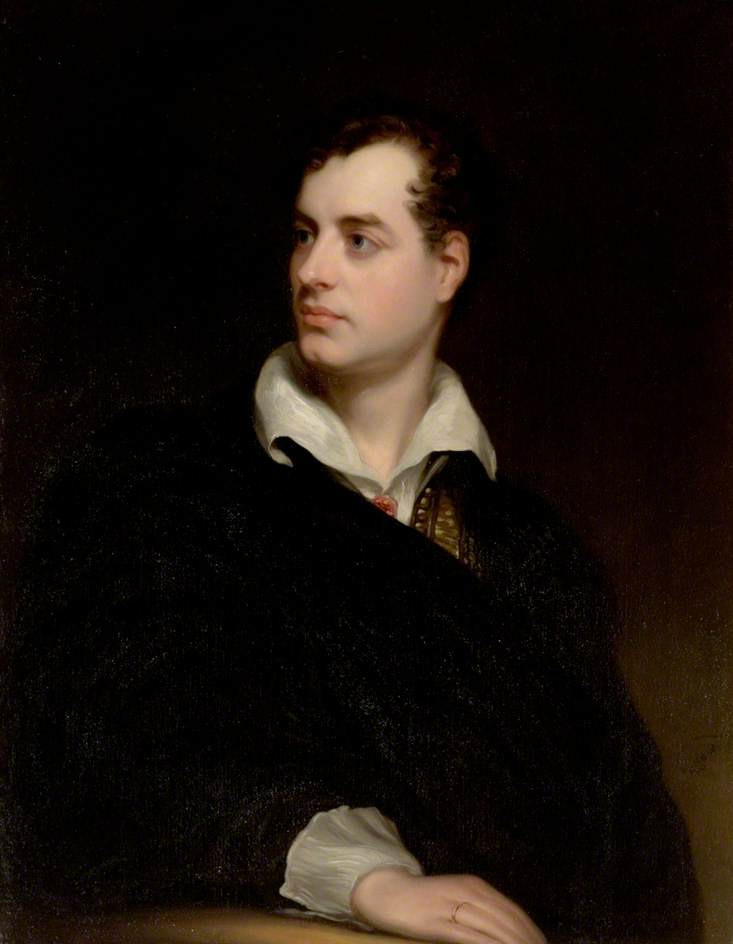
“Mad, bad, and dangerous to know”
― Lady Caroline Lamb
Oh this was a doozy of a biography. I haven’t read many biographies of historical figures, so I can’t definitively say that this is ‘thee‘ best one, but it was fairly freaking thorough and the research involved was such that this is probably as in depth a look as we are ever going to get of George Gordon Byron.
Because this is such a comprehensive biography this review feels kind of impossible. Byron may have only lived 36 years but he packed a lot into that 36 years. A lot of it worth dissecting, but I’m going to try just hit my highlights, if I started to dig into Byron’s life properly this would be a thesis.
So to start, it’s probably important that I divulge the fact that I went into this book a big Byron hater. As a fan of Frankenstein; or, The Modern Prometheus by Mary Shelley, a lot of my knowledge of Byron came from stories surrounding Shelley and her family. The main story that stuck with me was that of Shelley’s stepsister, Claire Clairmont, and the untimely death of Byron and Clairmont’s daughter Allegra. After reading this book I have a much better understanding of Byron and his relationship with Clairmont (who was no angel), and I can safely say that I hate him more. I have that most rare of insights now; well informed hate!
Now look, it would be impossible to read this and not recognise the genius of Byron. He was immensely talented and a true superstar of his day. He was also very troubled, a huge misogynist, and kind of terrible human being.
Byron had so unquenchable a thirst for celebrity, that no means were left untried that might attain it: this frequently led to his expressing opinion totally at variance with his actions and real sentiments… there was no sort of celebrity he did not, at some period or other, condescend to seek, and he was not very nice in the means, provided he obtained the end.
One of the most mind-blowing things in this book was learning how old the concept of the parasocial relationships with celebrities is. People being unhealthily obsessed with celebrities online was nothing on the fangirls of the early 1800’s. Women were sending him wigs worth of hair, and more than a few stalked him, with some even breaking into his house. Byron did what any unhinged celebrity would do, he encouraged and slept with some of these women, and then discarded them, usually in a very cruel way. He seemed to struggle a lot with the idea of celebrity, as the above quote suggests he wanted it all costs, but when he got it, he often resented it.
“If I do not write to empty my mind, I go mad.”
― George Gordon Byron
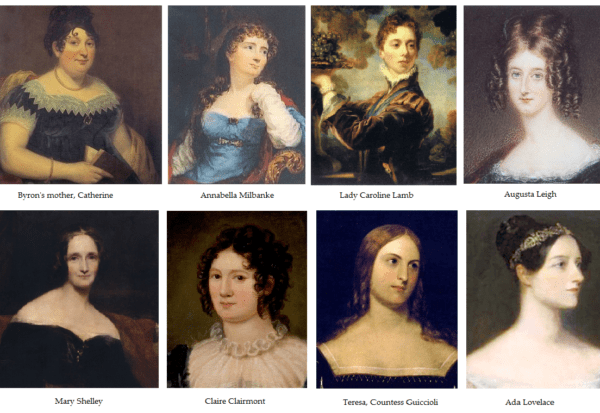
Along with his crazy unhealthy parasocial relationships, Byron also worked on cultivating crazy unhealthy romantic relationships. These ranged in both age (some ages very problematic) and sex. One of his most unhinged romances, (and I’m not going to lie, the most entertaining), was with Lady Caroline Lamb. I think today it would be very clear that Caroline was unwell, but oh boy did she cause a stir. Caroline is thought to have coined the famous quote about Byron being ‘mad, bad, and dangerous to know’. She was also instrumental in giving Annabelle Milbanke the proof she needed to obtain a divorce from Byron. She really giving a face to ‘hell hath no fury like a woman scorned’. Caroline Lamb went NUCLEAR, and I for one think he deserved it.
Byron, who had always resisted sharing his bed with a woman, made it clear that the marriage bed was no delight to him. He told Annabella that ‘one animal of the kind was good to him as another’, provided she was young.
I still honestly cannot understand what possessed this man to marry! There is a vague assumption in the book that the reason he married Annabelle Milbanke was to punish her for having rejected his original proposal, and honestly, that totally tracks. Byron punishing those who he perceives to have done him wrong, even at the expense of his one happiness, is very on point. He was often his own worst enemy, and his treatment of Annabelle was ultimately the beginning of his downfall. It put Caroline Lamb in a position to punish him for how he treated her, and this gave Annabelle the ammunition to punish him for how he treated her. And not to sound like a broken record, but he deserved to be exiled.
Some of the most interesting and infamous stories about Byron come from his exile on the continent. The famous house party with the ghost stories which brought us Mary Shelley’s Frankenstein happened in Geneva in 1816. His famous exploits in Venice with just about anybody who crossed his path happened between 1816 and 1818. And the events that led him to Greece.
“A drop of ink may make a million think.”
― George Gordon Byron
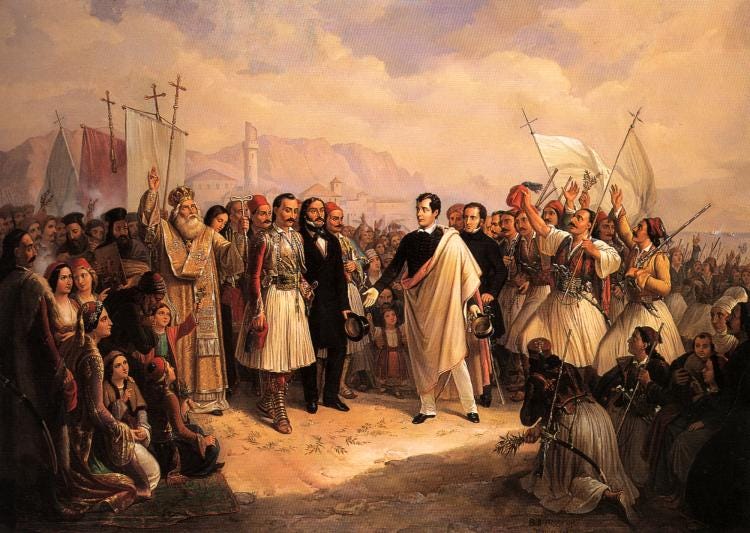
‘The fact is, riches are power, and poverty is slavery all over the earth, and one sort of establishment is no better, nor worse, for a people that another.’ ― George Gordon Byron
Byron may not have been the best of humans in how he lived his life, but I do feel like he did have the best of intentions when it came to most of his political motivations. I think he truly wanted to liberate Greece, and I don’t think him going to help with that liberation was a vanity project. It was very ill-advised, but I do think that he did it for all the right reasons. Unfortunately those reasons weren’t enough to keep him from dying. Neither were the physicians he had on hand, Dr Francesco Bruno and Dr Julius Millingen. On 9 April 1824, Byron fell ill, and what followed was what can only be described and an absolute shit show.
‘Have you no other remedy than bleeding? — there are many more die of the lancet than the lance.’
After Byron made this declaration he was practically hounded by both Bruno and Millingen, until he finally relented to being bled on 16 April after Millingen told him that “neither he nor Dr. Bruno could answer for the consequences’; the disease, Millingen added, might otherwise ‘operate such disorganisation in his cerebral and nervous system as to deprive him of his reason”. Of course Byron didn’t relent without telling both Doctors how he really felt about the matter:
Come; you are, I see, a d–d set of butchers. Take away as much blood as you will; but have done with it.”
They preceded to bleed him three times, although he did continue to fight the later bleedings. Between the second and third bleeding he stated:
‘if I am destined to die from this disease, I shall perish whether I am bled or whether I am left with all my blood.’
Unfortunately though, more ‘experts’ were brought in and it feels very much like a ‘too many cooks’ situation. It’s very apparent now, looking through a modern medical lens that the cure was what killed Byron.
Modern medical opinion attributes Byron’s death to an infection, with massive over-bleeding as an immediate cause. Dr. Raymond Mills, who has made a special study of Byron’s last illness, views the fever which began on 9 April as febrile illness not directly connected with the fit at the monastery two months before. He preposes Mediterranean tick fever, an infection spread by dog ticks, as more likely than the malaria most often assumed to have been the cause of Byron’s death. If this is the case then Lyon the Newfoundland and Moretto the bulldog are new candidates to blame. Dr. Mills has calculated Byron’s total blood loss from both lances and leeches as at least 2.5 liters, 43 per cent of his blood volume, a loss in itself great enough to have killed him. He was further dehydrated by purgings and blisters that were being applied.
I’m a little salty about the author mentioning the dogs here. I think given the time, we can’t blame Dr Francesco Bruno and Dr Julius Millingen for Byron’s death, but actually naming Lyon and Moretto and not Bruno and Millingen seems very unfair.
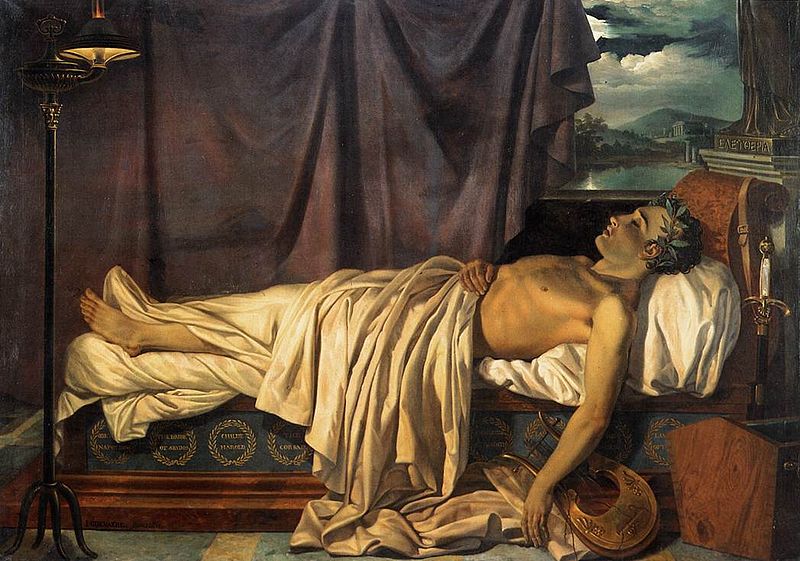
Ultimately George Finlay was right in his judgement that ‘the Genius of Lord Byron’ would in all probability never have unfolded either political or military talent. He was not disposed to assume an active part in public affairs.’
I added a question in this section when I was drafting this review, ‘What would Byron’s future have looked like had he not died when he did?’ Obviously that’s an impossible question to answer, but I, like George Finlay, don’t think he would have achieved much of anything in Greece. I think he provided boost in moral to those on the ground, but in the long run I don’t think he would have had any impact. I think he would have either died in actual battle, or gone back to Italy without achieving what he had set out to do. I think had he lived a long life, he would have burned so many bridges that he would have died destitute and alone. It probably sounds very harsh, and very cold, but I think he died at the best time he could have. His reputation wasn’t a good one, but had Byron made it back to Italy, I think he would have spent the rest of his life making it worse. As it stood, the reputation he left behind lives on in literature even today!
“And thus the heart will break, yet brokenly live on.”
― George Gordon Byron
I really appreciated the last section of this book. ‘The Byron Cult’ dealt with the repatriation of his body, and the influence he had on European and English art. The repatriation part was particularly fascinating, I was aware of his body being buried in England, but I honestly hadn’t thought about the logistics of getting it there from Greece in the early 1800’s. It was also super interesting learning about the fable of the ‘Byronic hero’, (which I kind of feel like he would have hated) and how that has shaped modern art. It’s given me a lot more to read about, that’s for sure.
Just to end, I usually read my non-fiction picks electronically or via audio, it has been a long time since I read a physical copy of a non-fiction book and I think that’s for the best. I tabbed this book to within an inch of it’s life, and it’s another reason this review was so difficult. There are so many quotes I wanted to use, but going through all the tabs to find them was a job in itself.
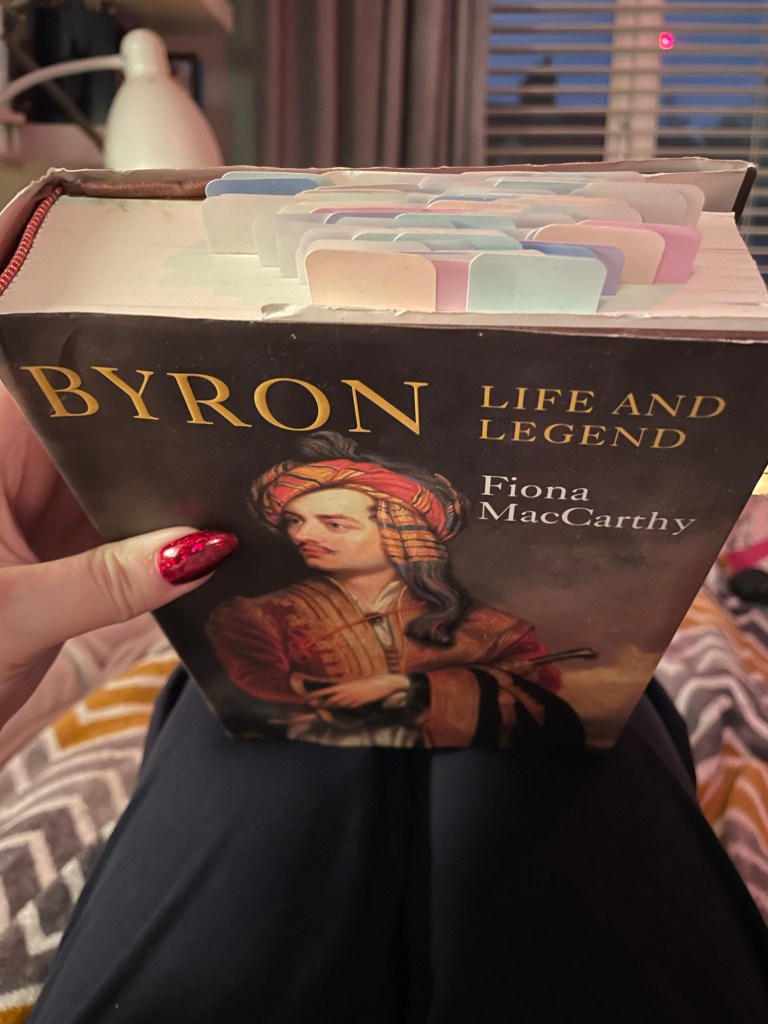
Ultimately I’m glad I read this, I know I said I’m a hater, and I definitely am that, but this wasn’t a hate read. Byron was an incredibly complex person and it was absolutely worth getting to know him. I was honestly shocked by how charismatic he seemed to be, so many were drawn to him, and often forgave him the most egregious of sins. I am a hater, but I too am very intrigued by him. I could see myself visiting Newstead or staying at Seaham Hall. That’s some powerful mojo he has going on, but I’m also nosey as fuck and Newstead looks cool, and a spa weekend in Seaham Hall would be for historical and relaxation purposes! 😀

Amazon UK – Byron: Life and Legend



One Comment Add yours